Binary to Text conversion becomes much easier when you understand how 8-bit binary values map to readable characters. Each 8-bit group can represent a byte, and character encodings such as ASCII assign numeric meanings to those byte values for letters, numbers, spaces, and symbols.
This guide explains how 8-bit binary conversion works, how to split binary into bytes, convert values accurately, read common ASCII characters, handle continuous strings, avoid mistakes, and understand when binary data may require encodings beyond ASCII.
What Is 8-Bit Binary to Text Conversion?
8-bit binary to text conversion is the process of interpreting groups of eight binary digits as byte values and mapping those values to characters using a suitable character encoding.
A binary digit can be either:
0
or:
1
Eight binary digits form one byte.
For example:
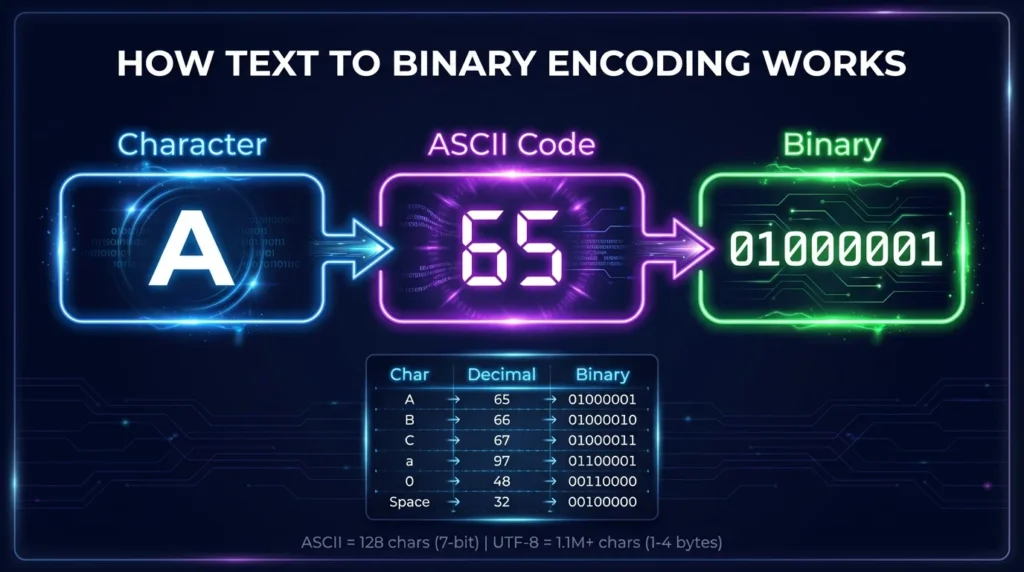
01000001
is an 8-bit binary value.
Its decimal value is:
65
In ASCII, decimal 65 represents:
A
So:
01000001 = A
When multiple bytes appear together, they can represent words or complete messages.
What Does 8-Bit Mean?
A bit is a single binary digit.
Eight bits grouped together form a byte.
For example:
01100001
contains eight bits.
An 8-bit value can represent decimal numbers from:
0
to:
255
because eight binary positions provide 256 possible combinations.
8-Bit Place Values
Each position has a specific decimal value:
| Binary Position | Decimal Value |
|---|---|
10000000 | 128 |
01000000 | 64 |
00100000 | 32 |
00010000 | 16 |
00001000 | 8 |
00000100 | 4 |
00000010 | 2 |
00000001 | 1 |
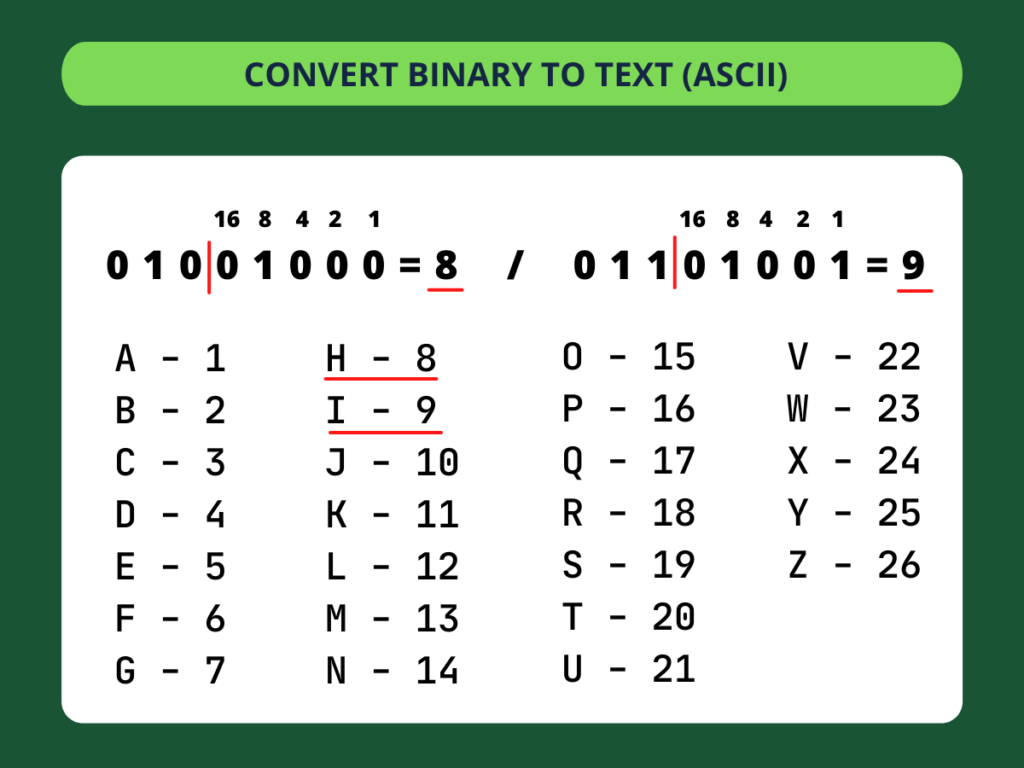
To convert an 8-bit binary value to decimal, add the values represented by positions containing 1.
How Does Binary to Text Work?
For basic ASCII text, the process follows:
Binary → Decimal → Character
Suppose the binary value is:
01000010
The active place values are:
64 + 2
Result:
66
ASCII decimal 66 represents:
B
Therefore:
01000010 = B
The same process can be repeated for each byte.
How to Convert 8-Bit Binary to Text Step by Step
Manual conversion can be completed in four simple stages.
Step 1: Split the Binary Into 8-Bit Bytes
Consider:
01001000 01101001
The input already contains two bytes:
01001000
01101001
If the binary contains no spaces:
0100100001101001
split it every eight digits:
01001000 01101001
Correct grouping is essential because every byte must begin and end in the right position.
Step 2: Convert Each Byte to Decimal
Take:
01001000
The active values are:
64 + 8
Result:
72
Now take:
01101001
The active values are:
64 + 32 + 8 + 1
Result:
105
Step 3: Match Decimal Values With Characters
Using ASCII:
72 = H
105 = i
Step 4: Combine the Characters
Join the characters in their original order:
Hi
Therefore:
01001000 01101001 = Hi
Binary to Text Example: HELLO
Consider:
01001000 01000101 01001100 01001100 01001111
Decode each byte:
| Binary | Decimal | Character |
01001000 | 72 | H |
01000101 | 69 | E |
01001100 | 76 | L |
01001100 | 76 | L |
01001111 | 79 | O |
Result:
HELLO
This demonstrates how individual 8-bit values combine to form readable words.
Binary to Text Example: Hello World!
A longer example is:
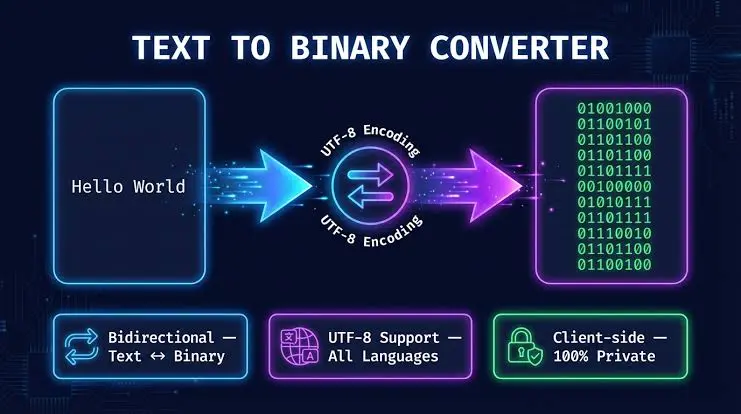
01001000 01100101 01101100 01101100 01101111 00100000 01010111 01101111 01110010 01101100 01100100 00100001
The important values include:
| Binary | Character |
01001000 | H |
01100101 | e |
01101100 | l |
01101111 | o |
00100000 | Space |
01010111 | W |
01110010 | r |
01100100 | d |
00100001 | ! |
Complete result:
Hello World!
The space is also encoded as its own byte:
00100000
How Are Letters Represented in 8-Bit Binary?
ASCII assigns different decimal values to uppercase and lowercase letters.
Common Uppercase Letters
| Letter | Decimal | Binary |
| A | 65 | 01000001 |
| B | 66 | 01000010 |
| C | 67 | 01000011 |
| H | 72 | 01001000 |
| M | 77 | 01001101 |
| S | 83 | 01010011 |
| Z | 90 | 01011010 |
Common Lowercase Letters
| Letter | Decimal | Binary |
| a | 97 | 01100001 |
| b | 98 | 01100010 |
| c | 99 | 01100011 |
| h | 104 | 01101000 |
| m | 109 | 01101101 |
| s | 115 | 01110011 |
| z | 122 | 01111010 |
Uppercase and lowercase characters must be decoded separately because they have different numeric values.
How Are Numbers Represented in 8-Bit Binary Text?
Numbers used as text characters also have ASCII values.
For example:
Character 0:
00110000
Character 1:
00110001
Character 5:
00110101
Character 9:
00111001
Binary Number vs Text Character
This distinction is important.
Binary:
00000101
represents decimal number:
5
But:
00110101
represents the text character:
5
The first value is numeric data.
The second is an encoded character.
8-Bit Binary Numbers 0–9
| Character | Decimal | Binary |
| 0 | 48 | 00110000 |
| 1 | 49 | 00110001 |
| 2 | 50 | 00110010 |
| 3 | 51 | 00110011 |
| 4 | 52 | 00110100 |
| 5 | 53 | 00110101 |
| 6 | 54 | 00110110 |
| 7 | 55 | 00110111 |
| 8 | 56 | 00111000 |
| 9 | 57 | 00111001 |
How Are Spaces and Symbols Represented?
Readable text contains more than letters and numbers.
ASCII also assigns values to spaces, punctuation, and common symbols.
| Character | Decimal | Binary |
| Space | 32 | 00100000 |
| ! | 33 | 00100001 |
| # | 35 | 00100011 |
| $ | 36 | 00100100 |
| % | 37 | 00100101 |
| & | 38 | 00100110 |
| + | 43 | 00101011 |
| – | 45 | 00101101 |
| . | 46 | 00101110 |
| / | 47 | 00101111 |
| ? | 63 | 00111111 |
| @ | 64 | 01000000 |
These values allow binary strings to represent readable sentences rather than isolated letters.
How to Convert Binary to Text Without Spaces
Binary data sometimes appears as a continuous string.
For example:
010000010100001001000011
If you know the input contains 8-bit character values, divide it into bytes:
01000001 01000010 01000011
Now decode each value:
01000001 = A
01000010 = B
01000011 = C
Result:
ABC
What If the Length Is Not Divisible by 8?
A continuous binary string intended to contain complete 8-bit bytes will normally have a total bit count divisible by eight.
If it does not, possible causes include:
- a missing bit;
- an extra bit;
- incorrect copying;
- a different encoding;
- non-byte-aligned data;
- a binary number rather than text.
Do not automatically add or remove bits unless you understand the original data format.
What Is ASCII?
ASCII stands for American Standard Code for Information Interchange.
It provides numeric codes for:
- uppercase letters;
- lowercase letters;
- numbers;
- punctuation;
- spaces;
- symbols;
- control characters.
Standard ASCII uses seven bits and contains 128 values from 0 through 127.
Why Are ASCII Characters Shown as 8 Bits?
Although standard ASCII uses seven bits, ASCII values are often displayed in an 8-bit byte by adding a leading zero.
For example:
7-bit ASCII for A:
1000001
8-bit representation:
01000001
Both have decimal value:
65
and both represent:
A
The 8-bit format makes byte boundaries easier to recognize.
Are All 8-Bit Values ASCII Characters?
No.
Standard ASCII only defines values:
0–127
An 8-bit byte can represent:
0–255
Values from 128 through 255 are outside standard ASCII.
Their meaning depends on the encoding being used.
This is why assuming every 8-bit value maps to a standard ASCII character can produce incorrect results.
8-Bit Binary vs ASCII vs UTF-8
These terms are related but not identical.
8-Bit Binary
An 8-bit binary sequence is simply a byte value.
Example:
01000001
ASCII
ASCII assigns character meanings to values from 0 through 127.
01000001 = A
UTF-8
UTF-8 is a Unicode encoding that can represent a much larger set of characters.
For standard ASCII characters, UTF-8 uses the same byte values.
For example:
A = 01000001
in both ASCII-compatible representation and UTF-8.
Characters outside ASCII may require two, three, or four UTF-8 bytes.
Why Some Binary Converts Into Unreadable Text
A binary string does not automatically contain readable text.
Several issues can create unexpected output.
The Data Is Not Text
Binary can represent:
- images;
- audio;
- video;
- software;
- compressed files;
- encrypted information;
- numeric values.
A Binary to Text converter only produces meaningful text when the binary data represents characters in a supported encoding.
The Wrong Encoding Is Used
Binary may represent text in:
- ASCII;
- UTF-8;
- UTF-16;
- another character encoding.
Using the wrong interpretation can produce incorrect characters.
The Byte Boundaries Are Wrong
If one bit is missing, all following groups may shift.
For example, properly grouped data:
01000001 01000010
means:
AB
Incorrect grouping can produce entirely different values.
The Value Is a Control Character
ASCII includes control characters that do not appear as visible letters, numbers, or symbols.
So valid binary data may produce no visible character.
Common 8-Bit Binary Conversion Mistakes
Removing Leading Zeros
A leading zero helps maintain an 8-bit byte.
For example:
01000001
is clearer as one complete byte than:
1000001
Mixing Numeric Binary With Text Encoding
00001001
is decimal 9.
It is not the ASCII text character 9.
Text character 9 is:
00111001
Assuming Every Byte Is Printable
Some byte values represent control codes or values outside standard ASCII.
Ignoring the Space Byte
00100000
represents a space.
Removing it can merge separate words.
Splitting Continuous Binary Incorrectly
Incorrect byte boundaries can change the meaning of the entire message.
Manual Binary Conversion vs Binary to Text Converter
Both methods have useful purposes.
When Manual Conversion Helps
Manual conversion is useful for:
- learning binary place values;
- understanding ASCII;
- checking individual bytes;
- solving educational exercises;
- verifying converter results.
When a Converter Is Better
A Binary to Text converter is more practical for:
- long binary messages;
- multiple bytes;
- continuous binary strings;
- fast conversion;
- reducing arithmetic errors.
Understanding the manual method remains useful even when you normally rely on an automated tool.
Quick 8-Bit Binary Conversion Method
For basic ASCII text, remember:
8-bit binary → decimal → ASCII character
Example:
01010011
Active values:
64 + 16 + 2 + 1
Decimal:
83
ASCII:
S
Therefore:
01010011 = S
For a full word:
01010011 01010101 01001110
becomes:
SUN
How to Check an Incorrect Binary to Text Result
If your output looks wrong, check the input before assuming the converter failed.
Verify the Binary Characters
Binary data should contain valid 0 and 1 digits.
Count the Bits
For byte-based text, verify that the groups contain eight bits.
Check the Encoding
Determine whether the source uses ASCII, UTF-8, UTF-16, or another format.
Verify Spaces and Separators
Make sure spaces between binary groups are separators and not part of some different format.
Check for Missing Bits
One missing or extra digit can shift every later byte.
Frequently Asked Questions
What Is 8-Bit Binary to Text?
8-bit Binary to Text conversion interprets groups of eight binary digits as byte values and converts them into readable characters using an encoding such as ASCII or UTF-8.
How Do I Convert 8-Bit Binary to Text?
Separate the data into 8-bit groups, determine each byte’s numeric value, match it with the appropriate character encoding, and combine the resulting characters.
What Is 01000001 in Binary to Text?
01000001 equals decimal 65.
In ASCII, decimal 65 represents:
A
Why Is Binary Text Often Grouped Into 8 Bits?
Eight bits form one byte, which is a common unit for storing and processing digital information. Displaying text as 8-bit groups also makes character boundaries easier to identify.
Is Every 8-Bit Binary Value a Letter?
No. A byte may represent a letter, number, punctuation mark, control code, encoding component, or non-text data depending on how it is interpreted.
How Do I Convert Binary to Text Without Spaces?
If you know the input uses 8-bit bytes, divide the continuous binary string every eight digits and decode each byte in order.
Is 8-Bit Binary the Same as ASCII?
No. Eight-bit binary simply represents a byte value. Standard ASCII is a 7-bit character encoding, although ASCII values are commonly displayed inside 8-bit bytes with a leading zero.
Can 8-Bit Binary Represent UTF-8 Text?
Yes, but not every UTF-8 character fits into one byte. ASCII-range characters use one byte, while many other Unicode characters require multiple UTF-8 bytes.
Final Thoughts
Binary to Text conversion is straightforward when the input contains correctly grouped 8-bit bytes and you know the character encoding being used. For standard ASCII examples, each byte can be converted to a decimal value and matched with a letter, number, space, or symbol.