Binary to Text conversion turns groups of zeros and ones into readable letters, numbers, spaces, and symbols. It works through character encoding systems such as ASCII, where each character has a numeric code. Understanding this process helps you decode binary messages and see how computers represent text.
In this article, you will learn how Binary to Text conversion works step by step, how to split binary into 8-bit groups, convert values into characters, avoid common mistakes, and decode examples accurately.
What Is Binary to Text?
Binary to Text is the process of converting binary code made from 0 and 1 into readable characters such as letters, numbers, punctuation, and spaces.
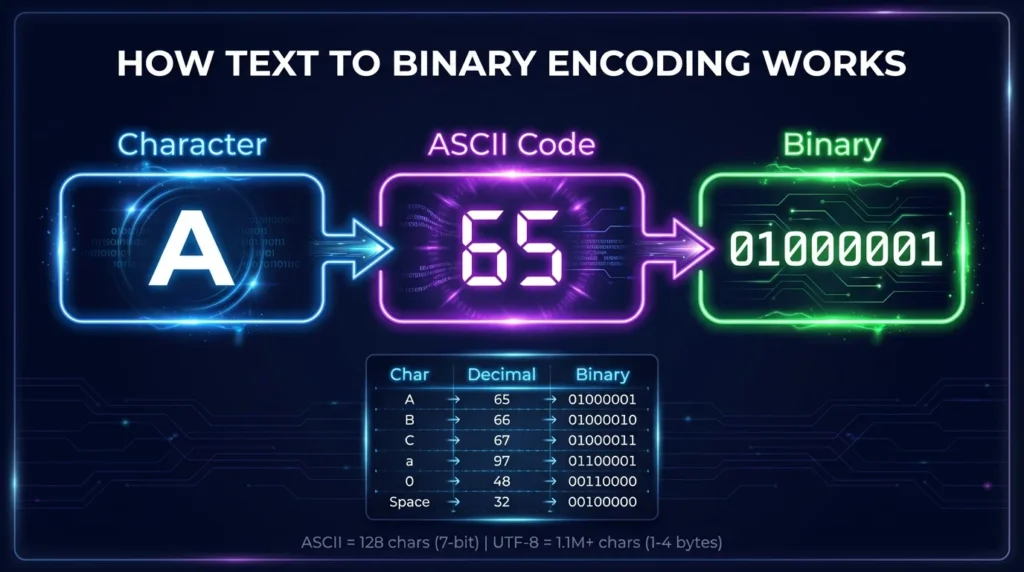
Computers store and process information using binary values. Character encoding systems such as ASCII assign numeric values to individual characters. These numbers can then be represented as binary.
For example:
01000001
has a decimal value of:
65
In ASCII, decimal 65 represents:
A
Therefore:
01000001 = A
A complete binary message may contain several binary groups.
For example:
01001000 01101001
becomes:
Hi
How Does Binary to Text Conversion Work?
Binary to Text conversion usually follows a simple process:
Binary → Decimal → Character
Each binary group represents a numeric value. That value is matched with a character in an encoding system such as ASCII.
Simple Binary to Text Example
Take this binary value:
01000010
Its active binary values are:
64 + 2 = 66
Decimal 66 represents:
B
So:
01000010 = B
The same method can be applied to every byte in a binary message.
How to Convert Binary to Text Step by Step
You can manually perform Binary to Text conversion using four basic steps.
Step 1: Split Binary Into 8-Bit Groups
Binary text is commonly shown in groups of eight digits.
A group of eight binary digits is known as a byte.
For example:
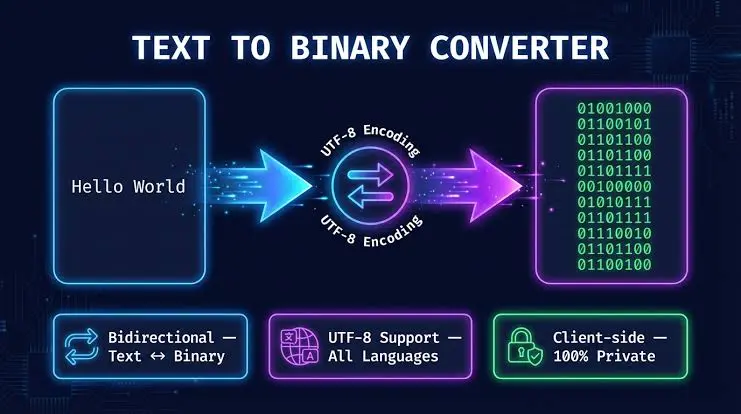
01001000 01100101 01101100 01101100 01101111
contains five separate bytes:
01001000
01100101
01101100
01101100
01101111
Each byte represents one character in this example.
If your binary code has no spaces:
0100100001100101011011000110110001101111
separate it every eight digits:
01001000 01100101 01101100 01101100 01101111
This makes Binary to Text conversion much easier.
Step 2: Convert Binary Into Decimal
Each position in an 8-bit binary number has a value.
| Binary Position | Decimal Value |
|---|---|
10000000 | 128 |
01000000 | 64 |
00100000 | 32 |
00010000 | 16 |
00001000 | 8 |
00000100 | 4 |
00000010 | 2 |
00000001 | 1 |
Consider:
01001000
The active positions are:
64
and
8
Add them:
64 + 8 = 72
Therefore:
01001000 = 72
Step 3: Match Decimal With an ASCII Character
Now check decimal 72 in an ASCII table.
Decimal:
72
represents:
H
So:
01001000 = H
Another example:
01101001
equals decimal:
105
ASCII decimal 105 represents:
i
Therefore:
01101001 = i
Step 4: Combine the Characters
Once all binary groups are decoded, combine the characters in the same order.
Example:
| Binary | Decimal | Character |
01001000 | 72 | H |
01100101 | 101 | e |
01101100 | 108 | l |
01101100 | 108 | l |
01101111 | 111 | o |
Final result:
Hello
Binary to Text Example: Hi
Consider this binary code:
01001000 01101001
Decode the First Byte
01001000
Decimal:
72
Character:
H
Decode the Second Byte
01101001
Decimal:
105
Character:
i
Final output:
Hi
Binary to Text Example: CAT
Binary:
01000011 01000001 01010100
Convert each byte:
| Binary | Decimal | Character |
01000011 | 67 | C |
01000001 | 65 | A |
01010100 | 84 | T |
Result:
CAT
Binary to Text Example: HELLO
Binary:
01001000 01000101 01001100 01001100 01001111
Conversion:
| Binary | Character |
01001000 | H |
01000101 | E |
01001100 | L |
01001100 | L |
01001111 | O |
Result:
HELLO
How to Convert Binary to Text Without Spaces
Binary code is sometimes written as one continuous string.
For example:
010000010100001001000011
If the sequence uses 8-bit bytes, divide it every eight digits:
01000001 01000010 01000011
Now decode each group:
01000001 = A
01000010 = B
01000011 = C
Final result:
ABC
Why Correct Byte Grouping Matters
Incorrect grouping can completely change the decoded result.
Binary:
01000001
represents:
A
If one bit is removed or shifted, the value may become a completely different character.
Always confirm the expected encoding before dividing an unknown binary sequence.
Binary to Text for Letters
Letters have specific ASCII values that can be represented in binary.
Uppercase Binary Letters
| Letter | Decimal | Binary |
| A | 65 | 01000001 |
| B | 66 | 01000010 |
| C | 67 | 01000011 |
| D | 68 | 01000100 |
| E | 69 | 01000101 |
| H | 72 | 01001000 |
| M | 77 | 01001101 |
| S | 83 | 01010011 |
| Z | 90 | 01011010 |
Lowercase Binary Letters
| Letter | Decimal | Binary |
| a | 97 | 01100001 |
| b | 98 | 01100010 |
| c | 99 | 01100011 |
| e | 101 | 01100101 |
| h | 104 | 01101000 |
| i | 105 | 01101001 |
| m | 109 | 01101101 |
| s | 115 | 01110011 |
| z | 122 | 01111010 |
Uppercase and lowercase letters use different ASCII values, so they also have different binary codes.
Binary to Text for Numbers
Numbers shown as text also have their own character codes.
For example:
The text character:
5
has decimal value:
53
Its binary representation is:
00110101
Therefore:
00110101 = "5"
Binary Number vs Text Number
The binary number:
0101
equals decimal:
5
But:
00110101
represents the text character:
5
These two values should not be confused.
Binary to Text for Symbols
Binary values can also represent symbols and punctuation.
| Symbol | Decimal | Binary |
| Space | 32 | 00100000 |
| ! | 33 | 00100001 |
| # | 35 | 00100011 |
| $ | 36 | 00100100 |
| % | 37 | 00100101 |
| & | 38 | 00100110 |
| + | 43 | 00101011 |
| – | 45 | 00101101 |
| . | 46 | 00101110 |
| ? | 63 | 00111111 |
| @ | 64 | 01000000 |
This allows Binary to Text conversion to produce complete sentences containing letters, spaces, numbers, and punctuation.
What Is ASCII in Binary to Text Conversion?
ASCII stands for:
American Standard Code for Information Interchange
It assigns numeric values to common text characters.
ASCII includes:
- uppercase letters;
- lowercase letters;
- numbers;
- punctuation;
- symbols;
- spaces;
- control characters.
Common ASCII Values
| Character | Decimal |
| A | 65 |
| B | 66 |
| Z | 90 |
| a | 97 |
| z | 122 |
| 0 | 48 |
| 1 | 49 |
| Space | 32 |
These values can be converted into binary and decoded back into text.
Is ASCII 7-Bit or 8-Bit?
Standard ASCII uses 7 bits and includes values from 0 to 127.
However, ASCII characters are commonly displayed as 8-bit values by adding a leading zero.
For example:
7-bit:
1000001
8-bit:
01000001
Both represent:
A
Using eight bits makes binary sequences easier to organize into bytes.
Binary to Text vs Binary to ASCII
Binary to Text and binary to ASCII are closely related when the binary data uses ASCII encoding.
Binary to ASCII Process
The conversion follows:
Binary → Decimal → ASCII Character
For example:
01010100
equals decimal:
84
ASCII decimal 84 represents:
T
Therefore:
01010100 = T
Can Binary to Text Be Converted Directly?
Yes.
If you have a binary ASCII chart, you can match each binary value directly with its character without calculating decimal first.
Examples:
01000001 → A
01000010 → B
01000011 → C
01100001 → a
01100010 → b
For longer messages, a Binary to Text converter can automate this process.
Binary to Text Converter vs Manual Conversion
Both methods are useful depending on your purpose.
Manual Binary to Text Conversion
Manual conversion is useful when you want to:
- understand binary;
- study ASCII;
- practice computer science;
- verify individual characters;
- learn binary place values.
Binary to Text Converter
A converter is more useful when you want to:
- decode long binary strings;
- process multiple bytes;
- save time;
- reduce manual errors;
- convert continuous binary values.
Manual conversion is best for learning, while automated conversion is more practical for larger data.
What If Binary Is Less Than 8 Bits?
Not every short binary value represents a text character.
For example:
0110
is four bits long.
As a binary number:
0110 = 6
However, the ASCII character:
6
is:
00110110
Therefore:
0110
does not automatically mean text character 6.
Check the Binary Data Type
Before using Binary to Text conversion, determine whether the data represents:
- a number;
- ASCII text;
- UTF-8 text;
- image data;
- software instructions;
- encrypted information;
- another binary format.
Binary can represent many different types of information.
Binary Number vs Binary Text
Binary values may look similar while representing different things.
For example:
1001
as a binary number equals:
9
But the ASCII character:
9
is:
00111001
So:
1001 = Decimal 9
while:
00111001 = Text character "9"
The meaning depends on how the binary data is encoded.
ASCII vs UTF-8 in Binary to Text
ASCII is commonly used for basic English text.
UTF-8 supports a much larger range of characters from Unicode.
ASCII Characters in UTF-8
Basic ASCII characters use the same values in UTF-8.
For example:
A
ASCII:
01000001
UTF-8:
01000001
Characters Outside ASCII
Many characters outside standard ASCII require multiple UTF-8 bytes.
Because of this, simple ASCII Binary to Text conversion is ideal for:
- English letters;
- numbers;
- spaces;
- standard punctuation.
Other characters may require proper UTF-8 decoding.
Common Binary to Text Conversion Mistakes
Several common mistakes can cause incorrect output.
Incorrect Bit Grouping
If the binary text uses 8-bit bytes, splitting it into the wrong group size can produce incorrect characters.
Missing Leading Zeros
Leading zeros help maintain consistent byte length.
For example:
01000001
should remain grouped as an 8-bit value when working with bytes.
Ignoring Spaces
A space has its own binary value:
00100000
Removing it can combine separate words.
Confusing Binary Numbers With Characters
Binary:
00000101
equals numeric decimal:
5
But text character:
5
is:
00110101
Assuming Every Binary String Is Text
Binary data may represent:
- images;
- audio;
- software;
- files;
- network data;
- compressed data;
- numbers.
Only binary encoded as text should be decoded using text character encoding.
Missing One Bit
Changing one bit can produce a different character.
For example:
01000001 = A
01000010 = B
Always check your binary input carefully.
How to Check Binary to Text Results
If your output is incorrect or unreadable, check the following.
Check the Bit Length
Make sure the binary groups use the expected number of bits.
Check Binary Characters
Binary input should normally contain:
0
and
1
Verify Byte Boundaries
Make sure continuous binary values have been divided correctly.
Confirm the Encoding
Check whether the data uses:
- ASCII;
- UTF-8;
- UTF-16;
- another encoding.
Look for Control Characters
Some ASCII values are control characters and do not display as visible text.
Quick Binary to Text Formula
You can remember the complete process using this formula:
Binary → Decimal → Character → Text
Example:
01000001
↓
65
↓
ASCII 65
↓
A
For multiple characters:
01000001 01000010 01000011
↓
65 66 67
↓
A B C
↓
ABC
Why Is Binary to Text Useful?
Understanding Binary to Text conversion helps explain how computers represent written information.
It is useful for learning:
- binary numbers;
- bits and bytes;
- ASCII;
- character encoding;
- computer memory;
- programming;
- data storage;
- digital communication;
- text processing.
Even when using an automatic converter, understanding the process can help you identify incorrect input and conversion errors.
Frequently Asked Questions
What Is Binary to Text?
Binary to Text is the process of converting binary values made from 0 and 1 into readable characters using an encoding system such as ASCII.
How Do I Convert Binary to Text?
Split the binary into appropriate groups, convert each group into decimal, find its matching character, and combine the characters.
What Does 01000001 Mean in Binary to Text?
01000001 equals decimal 65.
ASCII decimal 65 represents:
A
What Does 01100001 Mean?
01100001 equals decimal 97.
In ASCII, decimal 97 represents:
a
What Is 00100000 in Binary?
00100000 equals decimal 32 and represents a space character in ASCII.
What Is Hello in Binary?
Hello in 8-bit ASCII binary is:
01001000 01100101 01101100 01101100 01101111
How Do I Convert Binary Without Spaces?
If the binary uses 8-bit bytes, divide the continuous sequence every eight digits and decode each group.
Can Binary to Text Include Numbers?
Yes. Text characters such as 0 through 9 have their own ASCII binary values.
Can Binary to Text Include Symbols?
Yes. Binary can represent punctuation, spaces, numbers, letters, and other supported characters.
Is Binary Always 8 Bits?
No. Binary numbers can use different lengths. However, text is commonly represented in 8-bit byte groups.
What Is the Difference Between Binary to Text and Binary to Decimal?
Binary to decimal produces a numeric value.
Binary to Text interprets binary values through a character encoding system to produce readable characters.
Final Thoughts
Binary to Text conversion helps you understand how sequences of zeros and ones can represent readable letters, numbers, symbols, spaces, words, and complete messages. The basic method is to split binary into the correct groups, convert each group into its numeric value, identify the matching character, and combine the results.